
CTF vs hackathon: which should a beginner choose?
Find out whether you will be hunting flags or building a project, and prepare for the work your first event actually involves.
Stavleak Team · Updated October 7, 2026
You arrive ready to look for vulnerabilities. At the opening, you are asked to come up with an app for the city. The organiser has not necessarily made a mistake: you understood “hackathon” differently. Before signing up, find out what the event actually involves—solving prepared challenges or building your own solution.
In brief
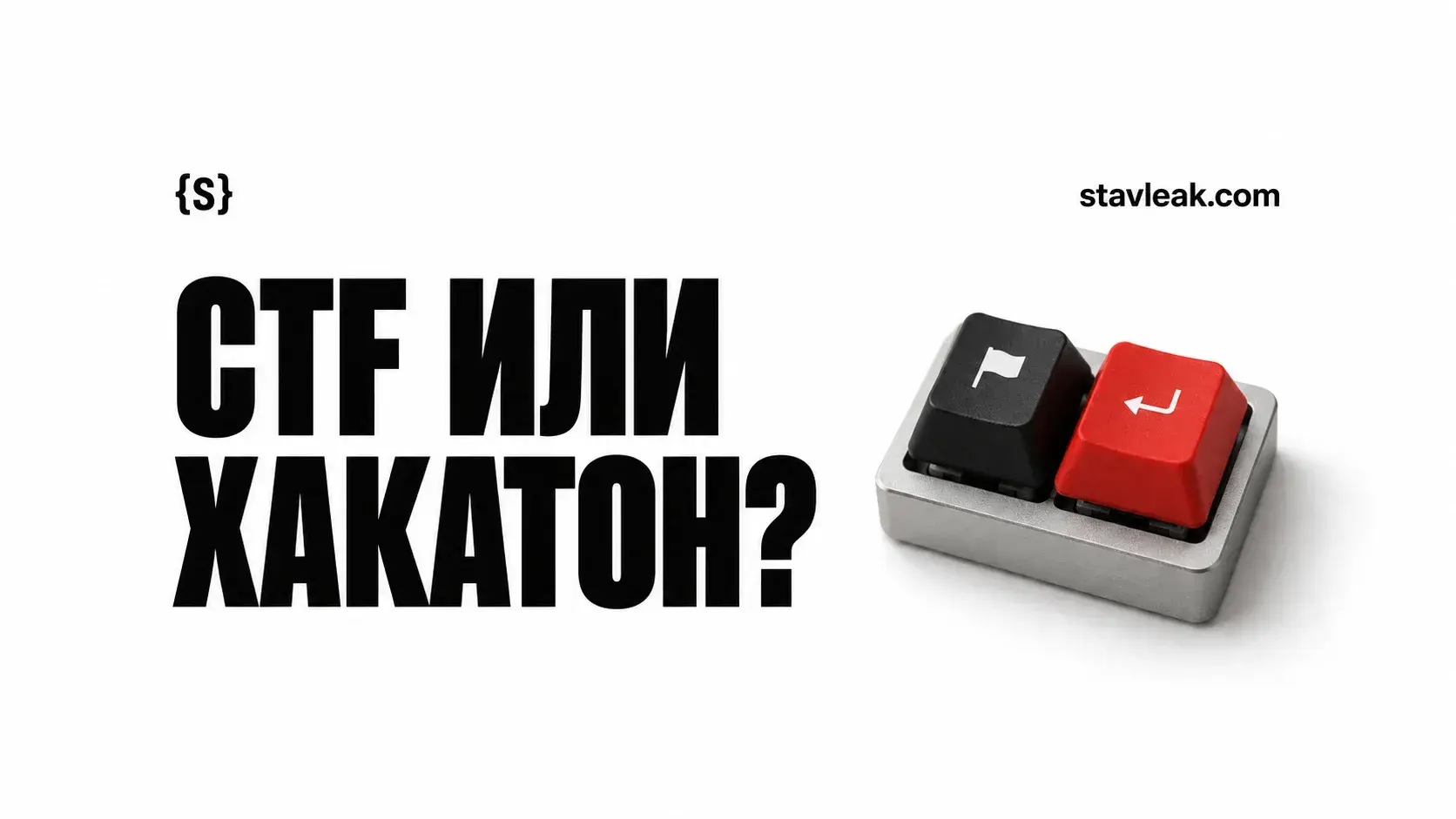
A CTF is a computer security competition. In a common format, participants solve challenges, find flags—strings containing the answers—and submit them for points. At a development hackathon, a team builds a solution and demonstrates it. Beginners should choose by the tasks, required skills and submission format, rather than the event’s name alone.
How does a CTF differ from a development hackathon?
Imagine two practice tasks. In the first, you receive a file with a hidden answer. You need to understand its structure, find the string and submit it for checking. In the second, you are asked to help students find available classrooms. You decide what data you need, build a prototype and show how to use it.
In the first task, your main job is to investigate a prepared challenge. In the second, it is to choose and implement your own approach. Both can involve programming, discussion and patience. What differs is the result you are expected to deliver.
- What does the organiser provide?
Challenge-based CTF: a set of tasks, files or practice services. Development hackathon: a theme, problem or track brief. - What do you do?
Challenge-based CTF: solve a prepared challenge. Development hackathon: build your own solution. - What do you submit?
Challenge-based CTF: a flag, plus any additional materials required by the rules. Development hackathon: a project and the materials required to demonstrate it. - What should you check beforehand?
Challenge-based CTF: categories, hints, environment and scoring. Development hackathon: prototype requirements and judging criteria.
The “answer → check → points” workflow is described in the CTFd documentation. For hackathons using MLH’s standard rules, demonstrating the project you built matters. These are examples of event formats; the event you choose sets its own precise requirements.
Do all CTFs work the same way?
No. A Jeopardy-style CTF presents a set of separate challenges. In Attack & Defense, teams also maintain their own services and work with other teams’ services within a designated environment. CTFd’s overview of CTFs explains this distinction. Before your first event, ask which format it will use. The word “cybersecurity” alone does not answer that question.
Scoring can differ, too. For example, CTFd supports dynamic challenge values, which decrease as more solutions are submitted. This is a system feature, not a mandatory rule for every CTF. Read the scoring description for your particular competition.
Should a beginner choose a CTF or a hackathon?
Start with the work that interests you. Do you enjoy figuring out why a program behaves strangely, investigating a file and testing hypotheses? Look at beginner CTF challenges. Would you rather make a useful tool, design a screen, connect data and show people an app? Explore a development hackathon.
Neither choice commits you to a career. For a first event, interest in a specific kind of work and a clear starting point are enough. “I want to work in IT” is broad. “I want to write a script that helps me understand this file” already gives your preparation a direction.
Do not judge your readiness only by programming languages. Python can be useful in different formats, but listing it on your CV does not tell you whether you can get started on a particular task. Ask for a challenge from a previous year or a description of what participants do at the beginning.
How can you check an event before registering?
Find answers to five questions on the event page:
- What result is expected? A flag, working service, hardware prototype, research or something else?
- Are there beginner tasks? Ask for an example if the description only says “all levels welcome”.
- How does the team work? Can you enter alone, how many participants are allowed and how is access shared?
- What is allowed during the event? Clarify the rules on hints, AI, outside help and publishing solutions.
- What environment do you need? Check the tools, connection method and boundaries of the authorised practice targets.
If the description is vague, send a specific question: “I know basic Python. Will participants solve prepared challenges with flags or build their own project? Is there an example of a starter task?” The answer will help you prepare more than an argument about terminology.
How should you prepare once you know the format?
For a CTF, practise getting started: read the brief, understand what you have been given, write down a hypothesis and test it. Work only with the targets specified by the organiser. Keep a note of what you tried; it will help you explain where you are stuck to a teammate.
For a development hackathon, try building one small, complete flow: input, action and a visible result. This rehearsal helps you get familiar with your tools. Check separately whether you can reuse its code in the competition.
You can compare tasks and entry requirements in the Stavleak hackathon catalogue. Open the full description and rules. A card’s title is only the start of your decision.
FAQ
Does a CTF mean hacking real websites that belong to other people?
The competition defines practice targets and an authorised environment. Taking part does not give you permission to test unrelated websites or infrastructure.
Can I participate without a team?
That depends on the event. Check whether individual participation is allowed and what team-size limits apply before registering.
If I cannot find vulnerabilities, are hackathons closed to me?
A development hackathon’s task may involve interfaces, data or another area. Look at the track requirements and the specific work you are ready to take on.
Sources
- CTFd: What is Capture The Flag? — differences between CTF formats.
- CTFd: Challenges — answer submission and points.
- CTFd: Dynamic Value — an example of scoring mechanics.
- MLH: Demos — project demonstrations in the relevant hackathon format.
The practice tasks in this article were created by the Stavleak Team as examples. This article was prepared with AI assistance and checked against primary sources.