Loading...



Registration is on the organizer’s site. Opens a new tab.
Medical AI. Undergraduate students worldwide; KZ teams participated.
Topic: Medical AI. Undergraduate students worldwide; KZ teams participated.
Format and location: In-person; Tashkent, Uzbekistan
Period: 27.03.2026 — 29.03.2026
Registration or submission deadline: deadline not confirmed
Current status: Completed
Kazakhstan eligibility: Yes — direct
Target audience: Undergraduate students
Age and other criteria: Under 25 years old
Team: Exactly 4; at least 1 CS/AI member
Primary language: EN
Fee: not published in verified materials
Awards: $7k / $5k / $3k
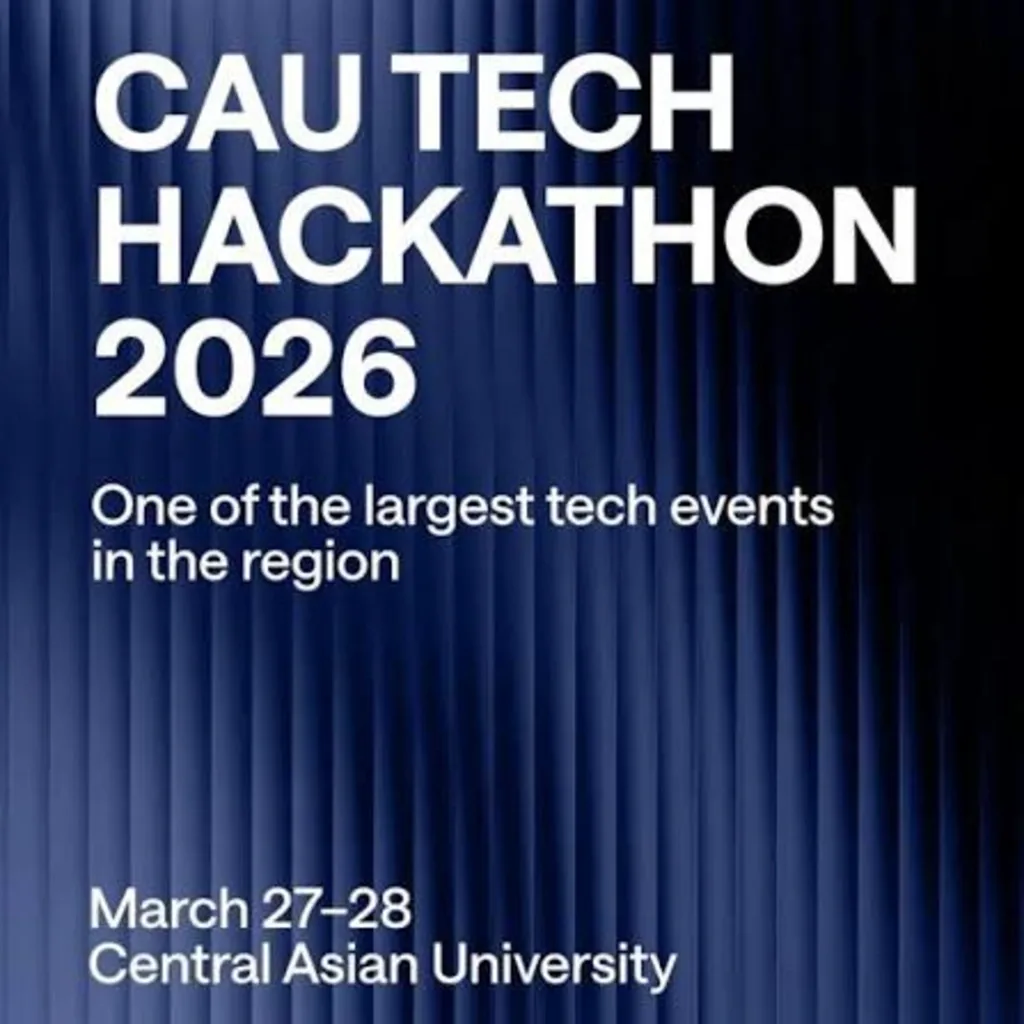
CAU Tech Hackathon 2026 — AI in Healthcare is an event in the field of "health, accessibility, and well-being." The recorded thematic formulation is: Medical AI. Undergraduate students worldwide; KZ teams participated.. The practical value of participation should be assessed not only by the size of the prize but also by the quality of the task, access to experts, the suitability of the result for a portfolio, the cost of preparation, and the probability of completing a strong submission in the available time. The status in the catalog is Completed, and the editorial priority is A — December 2026. This helps determine the order of work but is not a rating of the organizer and does not guarantee selection or victory.
For this topic, the central product question is: what verifiable user or specialist need does the product solve, and where is the boundary between support and medical approval. A strong team will be able to answer this in one sentence and then prove the answer with a working result. The most appropriate type of final artifact: a user journey prototype, an explainable model or support service, a scenario for a specialist, and documented limitations. This is an editorial recommendation derived from the topic; the official mandatory format should only be taken from the event website.
In the card, eligibility is marked as Yes — direct. The basis that was successfully recorded: Medical AI. Undergraduate students worldwide; KZ teams participated.. These two lines must be read together. The phrasing "Kazakhstan is not excluded" is weaker than a direct invitation to participants from all over the world, and the word "international" itself does not always mean the absence of restrictions on citizenship, residency, place of study, age, or sanctions compliance. If the meaning contains "conditionally," if the evidence is indirect, or if legal rules have not yet been published, it is worth getting a written response from the organizer before spending time.
The recommended request to the organizer should state the country of residence and citizenship, the proposed team composition, age or student status, the method of receiving the prize, and the chosen format of participation. It is better to save the response together with a snapshot of the rules version. Separately, check whether the platform applies its own restrictions, whether a Kazakhstani bank can receive the payment, whether a tax form is required, and whether it is allowed to participate on behalf of a company. These are not additional rules for this hackathon, but a standard risk check for an international application.
Target audience: Undergraduate students. Fixed criteria: Under 25 years old. Team composition info: Exactly 4; at least 1 CS/AI member. Before registration, each participant must independently confirm compliance with age, student status, residency, and other personal conditions. Unless permission for solo participation is explicitly stated, do not assume it is allowed. If the maximum team size is unknown, do not register extra people until you receive an answer from the organizer.
For a task in the field of "health, accessibility, and well-being," a rational distribution of roles looks like this: developer, UX/accessibility designer, subject researcher, and a person responsible for ethics, data, and fact-checking. One person can combine several functions, but there must be clear owners for the product, technical result, quality assurance, and final submission. It is useful to agree in writing in advance on contributions, the right to present the project, repository access, use of the result after the event, and distribution of a potential prize. Such an internal agreement is a recommendation and does not replace the platform's terms.
The working language is specified as EN. Even if the team communicates in Russian or Kazakh, prepare a unified glossary of terms in advance and designate a person capable of confidently answering jury questions in the required language. For an English-language submission, it is better to use short sentences, labels on diagrams, and subtitles for the demo. The goal is precision, not complex style.
Fixed format — In-person, location — Tashkent, Uzbekistan. Start: 27.03.2026; end: 29.03.2026; deadline: deadline not confirmed. Travel information: Travel at participant's expense. Online component availability by card: no; signs of mandatory in-person presence: yes. These signs are derived only from the field text and do not override event-specific rules.
For an online format, it is important for a team from Kazakhstan to convert the deadline to their time zone, check the time of mandatory sessions, the upload speed for large videos, and the availability of all APIs. Create a technical buffer of at least a few hours and do not leave registration until the moment of submission. For an in-person or hybrid format, first calculate the full budget: visa, flights, accommodation, insurance, local transport, food, and refundable deposits. The wording "travel support" does not mean automatic coverage of all costs. The value recorded for this event: Travel at participant's expense.
Participation cost is recorded as not published in verified materials. Prize information: $7k / $5k / $3k. Before making a decision, separate cash payments, grants, cloud platform credits, subscriptions, equipment, mentorship, and marketing wording about total value. Clarify the number of awarded teams, currency, deadlines, taxes, receipt restrictions, and the need to be present at the ceremony. If TBA, page discrepancies, or a re-verification requirement appear in the field, the amount cannot be used as guaranteed income.
Even without a cash prize, an event can be useful if it provides a strong case, public demonstration, feedback, or access to a community. However, paid services, travel, and several weeks of work have an opportunity cost. It is better to make the decision to participate based on three questions: can mandatory requirements be met; can a convincing result be assembled on time; will the created artifact be useful after the winners are announced.
For this direction, the following sequence is useful:
This strategy is not an official evaluation criterion. Its purpose is to help turn a broad topic like Medical AI. Undergraduate students worldwide; KZ teams участвовали. into an honest, verifiable, and completed prototype.
Documented risk: Requires a team of exactly 4 and early submission.. Next recommended step: Monitor December–February.
The current card does not sufficiently confirm: the exact time and time zone of the deadline; participation costs and mandatory fees. These points should be considered open questions, not permission to act on the most convenient assumption.
Practical go/no-go criterion: you should apply if the team documentarily meets eligibility, has access to the mandatory stack, has time to complete a verifiable scenario, and accepts the financial and logistical risks. Participation should be paused if the admission of Kazakhstan, submission rights, mandatory in-person presence, cost of critical services, or the procedure for paying out a significant prize is unclear.